
What Is Guest Behavior Architecture? A Framework for STR Properties.
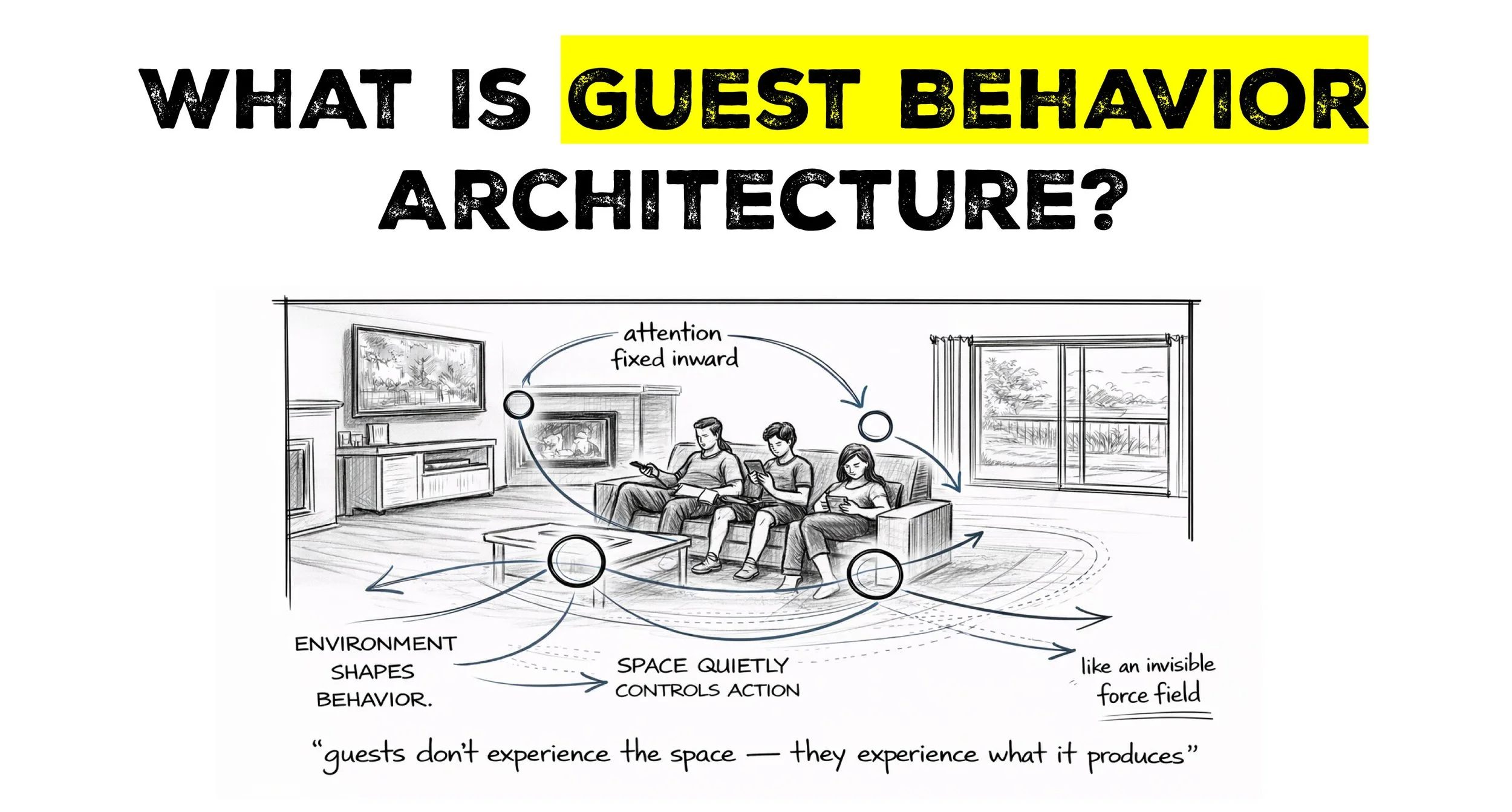
When a guest leaves a short-term rental and sits down to write their review, they do not describe the property. Not really. They describe what happened to them there.
They describe whether they slept. Whether they cooked the meal they planned. Whether the group gathered the way they hoped. Whether they found the thing they came for, or whether something kept getting in the way. They describe the experience in terms of what they did, what they felt, and what the stay produced in them as people. The physical environment is barely mentioned, except when it failed.
This is the observation that Guest Behavior Architecture is built on. Guests do not experience a property. They experience the behaviors the property produced in them. And those behaviors, every one of them, were either shaped intentionally by someone who understood how the environment works, or shaped accidentally by an environment that no one ever fully considered.
GBA is the discipline of making those behavioral outcomes intentional.
Why the STR Industry Has Needed This
The short-term rental industry has built its design conversation almost entirely around two things: visual appeal and functional adequacy. Does the property photograph well? Is it clean and functional enough to avoid complaints? These are reasonable questions. They are just not the right ones.
Visual appeal and functional adequacy are threshold conditions. They get a property into the consideration set. They earn the booking. What happens after the guest arrives is a different problem entirely, and it is one that the industry has largely left to chance.
The result is a pattern that shows up across thousands of STR reviews. Properties that look exactly like their photos but still generate feedback like something felt off or it was fine but not quite what we expected. Hosts who invest in better photography, updated furniture, and competitive pricing and still cannot close the gap between a good property and a great stay. Guests who leave satisfied but not delighted, who do not rebook, and who write reviews that are positive but not the kind that drive future bookings.
That gap, between the property as it appears and the stay as it is actually experienced, is where Guest Behavior Architecture operates. It is the gap that visual design alone cannot close, because the problem is not how the space looks. The problem is what the space does to the people inside it.
What Guests Actually Experience
Consider a specific scenario. A family books a beach house for a week. They arrive after a six-hour drive. The property is clean and looks like the listing. But the entry area has no clear place to drop bags and shoes. The kitchen counter has decorative items that need to be moved before anyone can start cooking. The outdoor furniture is arranged facing away from the view. The master bedroom has blackout curtains on one window and thin curtains on the other.
Nothing is broken. Nothing is dirty. No individual complaint would be unreasonable, but none is obvious enough to make. Over the course of seven days, this family will have slightly harder mornings because the light woke someone who needed more sleep. They will cook fewer meals than they planned because the kitchen resists it. They will spend less time on the outdoor space than they intended because it was not arranged for how they naturally wanted to use it. They will have a fine week. They will not have the week the property was capable of giving them.
They will not know why. They will write a four-star review. They will not rebook.
The host will see the review and look for what to fix. They will probably not find it, because the problem is not a thing. It is a pattern of small environmental signals that accumulated across seven days and produced outcomes nobody intended.
Guest Behavior Architecture is the methodology for seeing that pattern, naming it, and changing it.
Defining Guest Behavior Architecture
GBA is the study and intentional design of physical environments to produce specific behavioral outcomes in guests. It operates on a foundational principle: environments do not just contain behavior, they produce it. The way a space is organized, lit, scented, and laid out does not simply accommodate what guests do. It actively shapes what guests do, what they feel, and what they remember.
This principle is not new to design theory. Environmental psychology has documented the relationship between physical space and human behavior for decades. What GBA does is apply that relationship specifically and practically to the short-term rental context, where the stakes are a guest's experience of rest, connection, and enjoyment, and where the host has one opportunity per stay to get it right.
GBA is structured around four behavior zones, four friction types, and a three-step process. Each element is designed to answer a different question about the environment.
The four behavior zones — Arrival, Gathering, Restoration, and Experience — map the primary behavioral territories of any short-term rental. Each zone has its own behavioral priorities and its own failure modes. Understanding which zone a guest is in at any given moment, and what that zone needs to communicate, is the starting point for intentional environment design.
The four friction types — physical, sensory, informational, and emotional — identify the specific ways that environments interrupt intended behavioral outcomes. Friction is the mechanism through which an environment fails its guests. GBA categorizes friction not to create a checklist, but to give hosts and designers a shared language for what is actually happening when a stay underperforms.
The three-step process — Behavior Mapping, Friction Auditing, and Design Prescription — is the applied methodology. Behavior Mapping defines the intended behavioral outcomes for each zone. The Friction Audit identifies where and how the current environment is working against those outcomes. The Design Prescription translates the findings into specific, buildable changes. The Friction Map, the signature deliverable of the GBA process, documents all of this in a format that guides every subsequent design decision.
How GBA Differs from Standard Staging
Standard staging for short-term rentals is primarily a visual discipline. Its goal is an environment that photographs compellingly, reads as clean and inviting in a listing, and functions adequately enough to avoid negative reviews. These are legitimate goals. GBA does not replace them. It operates at a different level.
Staging asks: how does this space look? GBA asks: what does this space produce?
A staged space might be beautiful. A Staygineered space is designed to produce specific behaviors in every zone, and the beauty serves that purpose rather than existing independently of it. The decorative pillow arrangement that photographs well but creates an obstacle for guests going to bed is a staging decision that GBA would reject, not because it looks wrong, but because it produces the wrong behavior.
This distinction matters practically. A host investing in their property through the lens of staging asks questions about aesthetics and marketability. A host investing through the lens of GBA asks what they want guests to do, feel, and experience in each area of the property, and then designs backward from those answers. The resulting spaces often look similar in photographs. They feel different to live in.
The STR guest experience design conversation has long been dominated by visual benchmarks: is it Instagrammable, does it have a cohesive aesthetic, does it look like the kind of place that earns good reviews. GBA does not discard those benchmarks. It puts them in service of a more fundamental question about behavioral outcome. A space can meet every visual benchmark and still fall short, because visuals are what guests see before they arrive. Behavior is what they live through after they do.
Why This Framework Has a Name Now
The behaviors GBA addresses have always existed. Guests have always been shaped by the environments they stay in. Hosts have always, to varying degrees, made design decisions that affected those outcomes. What has not existed until now is a named, structured methodology for approaching that work intentionally in the short-term rental context.
Naming a discipline matters. It creates a shared language. It allows practitioners to communicate precisely about what they are observing and what they are designing. It separates the work from intuition and guesswork and establishes it as something that can be studied, applied, and refined.
The vacation rental experience framework that most of the industry is operating with, whether consciously or not, is built around guest satisfaction as a reactive measure. Something goes wrong, a review reflects it, the host addresses it. GBA inverts that process. It is a proactive design methodology that works from intended behavioral outcomes forward, not from past complaints backward.
Guest Behavior Architecture is that discipline. Staygineering is the practice of applying it. And the STR hosts who understand it earliest have a meaningful advantage over those who are still asking only what their space looks like, when the better question has always been what their space does.
The rest of this series is going to answer that question in detail, one zone, one friction type, one design decision at a time.