
Your Space Is Always Talking to Your Guests. Most Hosts Have No Idea What It's Saying.
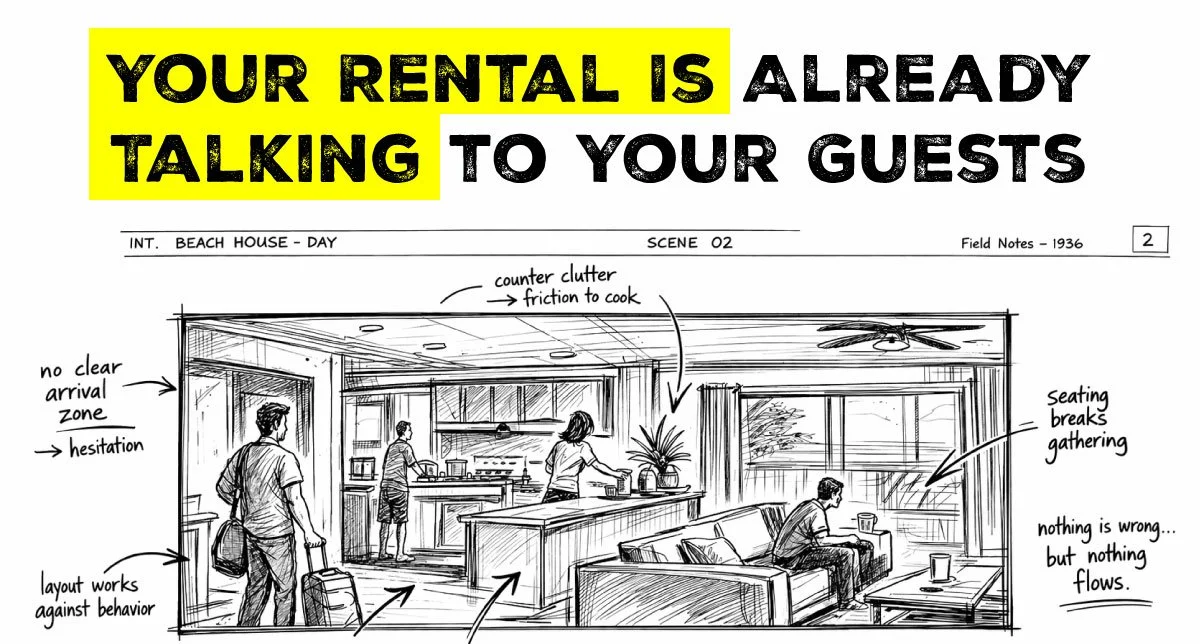
The moment a guest crosses the threshold of a short-term rental, something happens that most hosts never see. A conversation begins. Not a verbal one. The guest doesn't say a word. But the space does.
It communicates through the quality of the light in the entryway. Through the way the furniture is arranged and what that arrangement implies about how the space is meant to be used. Through the smell that meets them at the door. Through the visual noise of a surface that's trying to look styled but reads as cluttered. Through the absence of anything telling them where to go or what to do next. Through all of it, simultaneously, in the first thirty seconds of arrival.
That conversation is always happening. Whether the host designed it or not.
This is the foundational premise of Guest Behavior Architecture, the methodology at the core of how Staygineer approaches short-term rental environment design. Every space communicates. The question is never whether the environment is sending a message. The question is whether that message is intentional.
The Myth of the Neutral Space
Most hosts, when they think about their property between guest stays, imagine something close to neutral. A blank canvas that guests will layer their own experience onto. A comfortable, functional space that gets out of the way and lets the vacation happen.
That is not how environments work.
There is no such thing as a neutral space. Every decision made in the design, furnishing, and organization of a short-term rental carries meaning. And every decision that was not made deliberately carries meaning too. The space that received no intentional thought about guest flow sends a message about guest flow. The space with no clear gathering focal point sends a message about gathering. The kitchen that looks beautiful but is difficult to cook in sends a message about hospitality. None of those messages were intended. All of them were received.
This matters more in the vacation rental environment than in almost any other hospitality context, because the host is not present to correct the conversation. In a hotel, a staff member can bridge the gap between what the space communicates and what the guest needs. In a short-term rental, the space is on its own. It has to carry the entire guest experience without human backup. If it was not designed to do that job, the guest experience suffers in ways that show up in reviews, in star ratings, and in the gap between what the property could earn and what it actually earns.
Short-term rental staging strategy that accounts for this reality is fundamentally different from staging that is only thinking about photography. A space can look extraordinary in listing photos and still communicate the wrong things to a live guest standing inside it. The camera does not feel the friction. The guest does.
What Environments Actually Communicate
When Staygineer evaluates a property, the first step is understanding what the space is currently saying before any decisions are made about what it should say. That analysis looks at five primary communication channels.
Layout and flow. The physical arrangement of a space tells guests where to move, where to stop, and where they are not sure what to do. A clear flow through a well-considered space creates ease. An unclear flow creates hesitation, and hesitation creates friction.
Light. Lighting communicates mood, purpose, and permission in ways guests feel without consciously noticing. A space with only overhead lighting communicates something different from a space with layered lighting at different heights and intensities. One feels like a rental. The other feels like somewhere to actually be.
Scent. Scent is the most emotionally direct communication channel in any environment, and it is the one most hosts either ignore or get wrong. A space that smells like cleaning products communicates sterile, not clean. A space with a well-chosen, subtle scent communicates care. In many cases, the absence of any scent communicates better than the wrong one.
Organization and visual clarity. The way a space is organized tells guests how it expects them to behave. A kitchen with clear storage, visible tools, and logical prep space says cooking is welcome here. A kitchen where nothing has an obvious home says the opposite. Guests read these signals quickly and adjust their behavior accordingly, often without realizing it.
Guest-facing information. How a space communicates practical information — where things are, how things work, what the expectations are — is itself a form of environmental design. Information presented clearly and in context reduces friction. Information that is absent, buried, or presented in the wrong format creates it.
These five channels are always active. The vacation rental environment is always broadcasting across all of them. Guest Behavior Architecture is the discipline of making sure what they are broadcasting serves the stay.
The Four Behavior Zones
GBA structures the STR environment around four behavior zones, each with its own communication priorities and design requirements.
The Arrival Zone is the first conversation. It encompasses everything from the approach to the property through the first moments inside. This zone has one primary job: to signal to the guest that they are in the right place and that the stay is going to deliver on what was promised. Arrival Zone failures are expensive because they set the emotional tone for everything that follows. A guest who arrives and immediately feels uncertain, confused, or underwhelmed carries that feeling into every subsequent interaction with the space.
The Gathering Zone is where the shared experience of the stay happens. For most properties, this is the main living area and kitchen. This zone needs to communicate inclusivity, comfort, and permission. Permission to spread out, to cook, to gather, to actually use the space as if it belongs to them for the duration of the stay. Gathering zones that feel too precious, too staged, or too rigid communicate the opposite of what a guest needs to feel at home.
The Restoration Zone is the private retreat. Bedrooms, bathrooms, quiet spaces. This zone's primary communication priority is peace. It should signal that rest is possible here, that privacy is protected, and that the guest can genuinely decompress. Restoration zones that feel like afterthoughts — where the bedding is an obligation rather than a consideration, where the bathroom is functional and nothing more — miss the deepest emotional need the stay is designed to serve.
The Experience Zone captures the property-specific features that differentiate the stay: an outdoor space, a game room, a hot tub, a particular view. These zones should communicate their purpose clearly and remove every barrier to the guest actually using and enjoying them. An experience zone that a guest does not discover, does not understand, or cannot access without effort is revenue that was designed into the property and then accidentally designed back out.
Friction Is the Breakdown
Guest Behavior Architecture identifies four types of friction that interrupt the guest experience and work against what the environment is trying to communicate.
Physical friction is the most observable kind. It is the layout that does not make sense, the setup that requires effort to figure out, the space that fights back against what the guest is trying to do. Physical friction creates frustration and communicates neglect.
Sensory friction is subtler but equally powerful. It is the wrong lighting for the time of day or the activity, the smell that does not match the space, the temperature that is never quite right. Sensory friction creates discomfort that guests often cannot name but always feel.
Informational friction happens when guests do not know what they need to know to use the space confidently. Where do extra towels live? How does the TV work? What are the parking instructions? Informational friction creates anxiety, and anxious guests do not fully enjoy their stays.
Emotional friction is the deepest layer. It is the mismatch between what the property promised and what the guest actually experiences. The space that looked warm and inviting in photos but feels cold in person. The listing that implied a certain kind of stay and delivered a different one. Emotional friction destroys the experience because it breaks trust, and broken trust does not recover during a single stay.
Identifying and eliminating friction across all four types is the core practical work of Guest Behavior Architecture. The Friction Audit is GBA's primary diagnostic tool, and the Design Prescription that follows it is how Staygineer translates those findings into specific, buildable changes to the environment.
Making the Conversation Intentional
Nothing about the guest experience happens by accident. That is not a hope or an aspiration. It is a design principle. The environments that deliver consistently exceptional stays are the ones where someone made deliberate decisions about what the space should communicate, in every zone, across every channel, before the first guest ever arrived.
That deliberate process is Staygineering. And it starts with accepting one thing: your space has been talking to your guests since the day you listed it. The only question is whether you have been directing the conversation.
The Environment Series exists to show exactly how that direction works. Each post in this series takes one aspect of the STR environment, including a zone, a friction type, a communication channel, or a specific design decision, and examines it through the lens of Guest Behavior Architecture. The goal is not inspiration. It is clarity. A clear understanding of what the environment is doing and a clear path to making it do what the stay requires.
That work starts here.